
Education brands should evaluate Montessori furniture and wooden chalkboards as products children will climb on, lean against, move and use repeatedly, not as decorative classroom pieces. A good supplier brief starts with the child’s age, the learning activity and the environment in which the product will be used. Only then should the brand discuss wood species, colour and packaging.
Wonfulity custom wooden products include learning towers, tables and chairs, bookshelves, floor beds, climbing frames, educational toys and kids’ chalkboard easels. The company describes custom options in solid wood, plywood and composite materials, together with colours, sizes, functions and personalised patterns. That breadth is useful for a coordinated collection, but each item still needs its own risk assessment and measurable specification.
Define the learning function before drawing the product
“Montessori style” is not a complete design instruction. A low shelf is intended to let a child see and reach materials independently; a learning tower brings the child to counter height; a chalkboard easel supports drawing and mark-making. Each function creates different requirements for dimensions, stability, access and supervision.
For a chalkboard, specify whether one or both sides are usable, whether the surface is chalk, whiteboard, magnetic or paper-roll compatible, and how the child changes sides. For furniture, specify the intended posture and reach. A table designed for toddlers should not simply be a scaled-down adult table; seat height, knee clearance, edge profile and the relationship between chair and tabletop must be considered together.
Brands should provide an age range and expected setting such as home, preschool, daycare or retail activity area. The supplier can then review the concept against the relevant market requirements. The same product may need different warnings, test methods or supervision language depending on how and where it is sold.
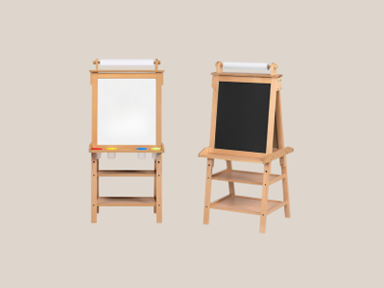
A chalkboard easel should be assessed for stability, pinch points, surface durability and the way children change or move its parts.
Stability is a design result, not a final inspection item
Children apply forces that a catalogue photograph cannot show. They pull the top of an easel, sit on a shelf, use a learning tower as a step and lean backwards on a chair. Stability should therefore be reviewed during the concept stage. The base footprint, centre of gravity, spread of legs and location of shelves or trays all affect resistance to tipping.
Ask the supplier for critical dimensions and a prototype that can be tested on the floor surfaces expected in use. If the product folds or adjusts, evaluate every configuration. A lock that works when new should remain clear and secure after repeated cycles. Folding joints also need protection against finger entrapment.
For taller furniture such as learning towers or bookshelves, decide whether anti-tip hardware or attachment instructions are required. The product, packaging and assembly guide must tell the same story. A bracket included in the carton has little value if the instructions do not show where and why it is used.
Specify materials by performance and traceability
Wonfulity lists solid wood, plywood and eco-friendly composite material options, with FSC-certified wood available for environmentally conscious clients. Each option has advantages, but the bill of materials should identify what is used in every structural and visible part. “Wooden product” can otherwise hide a mix that changes between sample and bulk production.
Solid wood may offer a natural appearance but requires control of moisture, grain defects and dimensional movement. Plywood can provide stable panels, but face quality, core gaps and edge finishing need standards. Composite panels require attention to emissions and edge sealing. The correct choice depends on structure, finish, target price and the regulations of the destination market.
Request material records and define acceptable substitutions. If FSC sourcing is part of a marketing claim, the brand should confirm the chain-of-custody documentation and claim wording applicable to the order. Sustainability language should be supported by purchasing records rather than added only to packaging.
Finish quality must survive classroom use
Wonfulity states that it uses eco-friendly, non-toxic paints and can match brand colours. For a buyer, the next step is to specify the finish system, colour reference, sheen and applicable chemical or coating requirements. A colour chip or screen value alone does not define adhesion, rub resistance or resistance to cleaning.
Chalkboard and whiteboard surfaces need their own performance sample. Test writing, erasing, ghosting and repeated cleaning with the intended materials. Check whether chalk dust collects in inaccessible gaps and whether a tray can be removed safely. A decorative black panel is not automatically a durable chalk surface.
Inspect exposed edges and corners by touch as well as sight. Sanding should remove splinters without creating inconsistent profiles. Painted edges should not reveal rough fibres. Where parts rub during folding or adjustment, the finish should not quickly wear through.
Hardware and small parts require a complete review
Fasteners, hinges, magnets, knobs and caps can determine whether a wooden product remains safe in use. The specification should identify material, finish, size, locking method and accessibility. Confirm that screws cannot loosen into accessible small parts and that hardware does not create sharp projections.
For a double-sided easel, examine the pivot, stop and locking mechanism. Can the panel move unexpectedly? Can a finger enter the closing gap? Does the product remain stable while the panel is turned? These questions should be answered with the assembled sample and repeated-cycle testing, not only a drawing.
If the product includes accessories such as chalk, erasers, magnets or paper clips, evaluate them as part of the set. Age grading and warning decisions must include everything in the retail package.
Sampling should imitate real use
Wonfulity describes a process of needs analysis, design proposal, sample production, production, quality control and delivery. Education brands can make that process more effective by supplying a sample test plan at the beginning. The plan should cover assembly, dimensions, static load, stability, impact where relevant, moving-part cycles, surface durability and packaging.
Use the sample as an engineering checkpoint rather than a photo opportunity. Assemble it with the draft instructions and ordinary tools. Record time, confusing steps and any force needed to align parts. Then disassemble or move it as a customer might. A product that requires factory skill to assemble is not ready for retail.
After functional approval, retain a signed master sample and controlled drawings. Bulk inspection can then compare dimensions, colour, finish, hardware and packaging with agreed references. Written defect examples help the supplier and inspector distinguish acceptable natural variation from a real quality problem.
Packaging is part of the product experience
Wooden furniture and easels can be damaged by corner impacts, abrasion and moisture during transport. The pack design should protect finished surfaces without leaving marks or trapping loose hardware against panels. Run drop, vibration and compression checks appropriate to the distribution route.
Count and label every fastener. Group hardware by assembly step when possible and include a spare policy for small components. Instructions should use clear drawings, show the finished orientation and identify all safety attachments. Brands selling across languages should minimise ambiguous text and validate translations.
Carton size also affects commercial viability. A small design change that reduces empty space can lower freight and storage cost, but it should not weaken the product or force an assembly experience that customers dislike. Packaging optimisation should follow prototype approval, not drive unsafe structural compromises.
Audit the production process behind the sample
The website’s wooden toy and furniture categories shows the categories a buyer can develop. Before scaling, the brand should ask how the factory controls incoming wood, moisture, cutting, sanding, drilling, coating, assembly and final inspection. The strongest sample is not enough if bulk production lacks repeatable controls.
Confirm which processes are performed in-house, how colour batches are approved and how nonconforming parts are isolated. For a mixed collection, check whether the same material and colour references are used across tables, chairs, shelves and chalkboards. Consistency is a brand requirement that spans individual product lines.
The supplier decision should be evidence-based
A suitable wooden chalkboard or Montessori furniture supplier is one that can turn a learning objective into controlled dimensions, materials, hardware, finish and test evidence. Attractive styling matters, but it should come after stability, child interaction and compliance have been designed.
Education brands can make better supplier comparisons by sending the same structured brief to every candidate and asking for the same sample evidence. When the conversation moves beyond price and appearance, it becomes much easier to judge whether a factory can support a safe, repeatable and genuinely useful product line.
